
× a city that never stops surprising

Welcome to Málaga, one of the most enjoyable city breaks in southern Europe. Set between the Mediterranean and the mountains, it combines an atmospheric historic centre, a lively port, urban beaches, excellent museums, and a relaxed street life that visitors tend to fall for very quickly.
What makes Málaga stand out is balance. You can spend the morning among Roman and Islamic landmarks, pause for lunch in a market or beachside chiringuito, walk through world-class art collections in the afternoon, and finish the day with sunset views over the bay. Few cities make that mix feel so easy.
This guide is designed to help you enjoy Málaga at a slower, smarter pace: what to see first, which neighborhoods are worth your time, what to eat, how to move around, and why the city feels so much bigger in experience than it does on the map.


× step into history: palaces, fortresses, and ancient theatres
If it is your first time in the city, begin with the Alcazaba. This fortress-palace is one of Málaga’s essential monuments, and walking through its gateways, gardens, courtyards, and defensive walls is one of the best ways to understand the city’s layered past. The views over the centre and the port are reason enough to go, but the atmosphere is what lingers.
At the foot of the hill sits the Roman Theatre, the city’s main surviving Roman landmark. Its position, directly below the Alcazaba, makes this one of the most striking historical pairings in Málaga: Roman remains in the foreground, Islamic fortifications above, and the modern city all around them.
Just a short walk away rises the Cathedral of Málaga, known locally as La Manquita because one of its towers was never completed. The nickname is affectionate, but the building itself is monumental: elegant on the outside, richly detailed within, and one of the landmarks that gives the historic centre its unmistakable silhouette.
One of Málaga’s great advantages for visitors is how close all of this is. You can move from the Roman world to Islamic Málaga and then into the Christian city in a single easy walk, without needing transport or spending half the day navigating between sights.

× a city of artists: Picasso, Pompidou, and street murals
Málaga has turned culture into one of its strongest calling cards. It is the birthplace of Pablo Picasso, and the Museo Picasso Málaga remains one of the city’s most rewarding visits. Housed in the Palacio de Buenavista, it offers a broad look at the artist’s creative evolution in a setting that feels both elegant and approachable.
Nearby, the Picasso Birthplace Museum adds a more personal angle, linking the international figure to the city where his story began. Even visitors with only a casual interest in art often come away with a stronger sense of Málaga’s cultural identity after seeing both places.
Then there is the Centre Pompidou Málaga, instantly recognizable by its colorful glass cube beside the port. It brings modern and contemporary art into a bright waterfront setting and helps explain why Málaga now appeals not only to beach lovers and weekend visitors, but also to travelers who plan entire trips around museums and exhibitions.
For a different mood, the Carmen Thyssen Museum focuses on Spanish and especially Andalusian painting, while the SOHO district adds murals, independent venues, and a more urban creative energy. Together, they show a city that values heritage without feeling trapped by it.

× food that tells a story
Málaga is a city where eating well feels wonderfully uncomplicated. The classic dish visitors remember most is the espeto de sardinas, skewered sardines cooked over an open fire, usually right by the sea. It is simple, local, and exactly the kind of meal that tastes better because of where you are eating it.
You will also come across plenty of pescaito frito, seafood tapas, salads made for warm weather, and sweet local wines that speak to the province’s long winemaking tradition. The best approach is not to overplan: combine old-school taverns, neighborhood bars, market stops, and one or two more contemporary kitchens.
The Mercado de Atarazanas is one of the best places to understand the city through food. It is both a working market and an architectural landmark, lively in the mornings and full of color, conversation, and produce from sea and inland countryside alike. This is where Málaga feels local in the most immediate way.
And while the city has embraced newer dining trends, its real strength is still recognisable flavor: seafood, olive oil, seasonal vegetables, rice dishes, grilled fish, and the kind of informal tapas culture that turns lunch into a long and very convincing argument for staying out a little longer.

× streets made for wandering
Málaga is made for walking. Start along Calle Marqués de Larios, the city’s elegant main street, and continue into the plazas and side streets that form the historic centre. What matters here is not only what you are heading toward, but everything you notice on the way: old façades, small churches, shaded squares, terraces filling up, and the steady rhythm of daily life.
From Plaza de la Constitución to Plaza de la Merced, the city feels open, social, and easy to read. It is ideal for visitors who enjoy discovering places on foot rather than rushing between landmarks. Málaga rewards curiosity: a turn down a quieter street can lead to a hidden courtyard, a traditional bar, or an unexpected view.
In the evening, the same streets take on a different character. Lights come on, terraces become busier, and the centre feels lively without losing its charm. Even with a plan, leave room for spontaneity. In Málaga, some of the best moments happen between the places you meant to visit.

× festivals that take over the city
Two celebrations define Málaga’s festive identity for many visitors. The first is Semana Santa, when the city fills with processions, music, incense, and an intensity that is both religious and cultural. Even for non-religious visitors, it can be one of the most powerful times to experience the city’s traditions.
The second is the Feria de Málaga, held in August, when the city shifts into full celebration mode. The historic centre hosts the daytime atmosphere, while the fairground takes over at night with music, lights, casetas, and a festive energy that spills across the city. If you enjoy seeing Málaga at its most outgoing, this is the moment.

× beyond the center: neighborhoods with character
Málaga is compact, but stepping beyond the historic centre adds a lot to the experience. To the east, Pedregalejo and El Palo keep much of their old seaside identity and are ideal for a slower afternoon by the water. This is where many visitors go for a long lunch, a beach walk, and some of the city’s most atmospheric chiringuitos.
Above the centre, Gibralfaro Castle offers one of the classic panoramic views of Málaga. From up there you see the cathedral, the port, the bullring, the coastline, and the scale of the city in one sweep. It is one of the best places to understand Málaga’s geography and one of the easiest viewpoints to recommend.
Meanwhile, the SOHO district brings a more contemporary side of Málaga into view, with murals, cultural spaces, theatres, and a different urban texture. Together, these neighborhoods show why the city works so well for repeat visits: there is more to it than a checklist of monuments.

× getting around Málaga
Málaga is refreshingly manageable for visitors. The historic centre is highly walkable, and many of the main sights are close enough to combine in a single route. For short stays, this is one of the city’s biggest strengths: you spend more time enjoying the place and less time commuting across it.
When you need transport, the city is well connected by bus, metro, and Cercanías train. The airport is very close to the centre, and the C1 train makes it easy to reach Málaga quickly, which is one reason the city works so well for weekend breaks as well as longer stays.
For most visitors, renting a car is unnecessary unless you plan multiple day trips inland. Within the city itself, walking and public transport usually cover everything you need, from the centre to the beaches and the main transport hubs.
× a lifestyle hard to leave behind
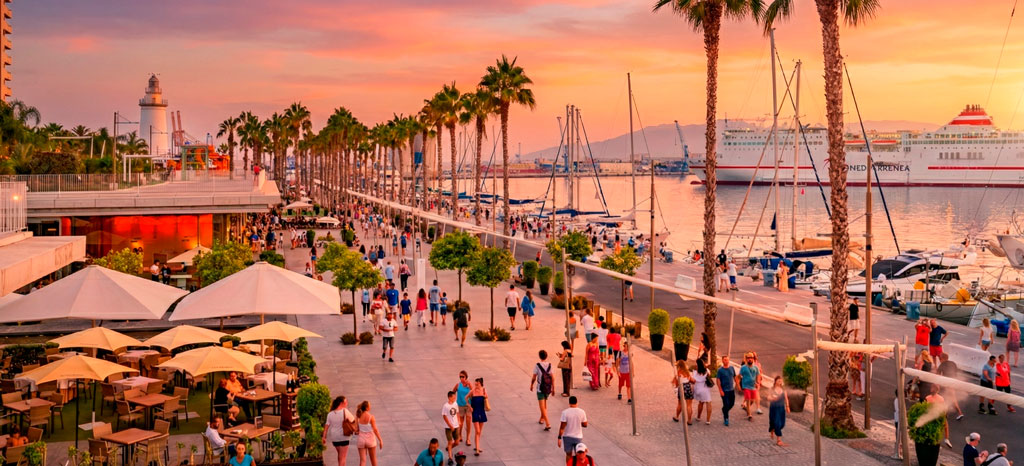
Málaga’s appeal is not only about monuments, museums, or weather. It is also about the way the city is lived: coffee on a terrace, long lunches, evening walks, beach time without needing to leave town, and a cultural scene that feels accessible rather than intimidating. It is a city that makes visitors slow down in the best possible way.
Give yourself time here. Do not reduce Málaga to a checklist. Sit in a square, browse a market, follow a street because it looks interesting, stop for an extra tapa, and leave room for the city’s everyday side to do its work. That is often when Málaga feels most memorable.
Because in the end, Málaga is not simply a destination for sunshine and photos. It is a place with real character: historic but open, cultural but unpretentious, lively without losing its local rhythm. And that combination is exactly why so many visitors arrive for a few days and immediately start thinking about coming back.
